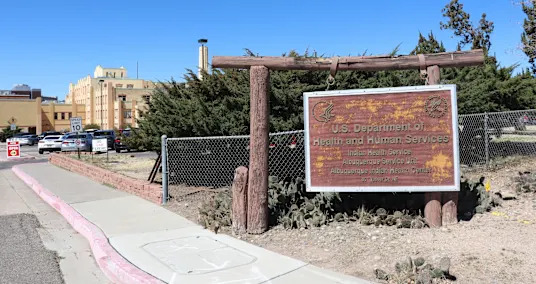
SANTA ANA PUEBLO, N.M. (AP) — An empty lot between a fire station and a soccer field just outside Albuquerque soon will be the home of a federal medical center first promised to Native American patients more than 30 years ago.
Earlier this month, Santa Ana Pueblo Gov. Myron Armijo took officials from the U.S. Indian Health Service and the Department of Health and Human Services on a tour of the location where patients are to receive everything from dialysis and diabetes care to optometry services.
"This will definitely change the game for healthcare in our area,” Armijo said.
Set to break ground in 2027, the 235,000-square-foot (22,000-square-meter) center will be run by the IHS, the U.S. agency that provides healthcare to Native Americans. Tribal leaders hope it will relieve pressure on the aging and overextended Albuquerque Indian Health Center, a federal facility originally built 90 years ago where some patients report waiting months for an appointment.
The Albuquerque facility was among more than 60 clinics and hospitals the agency identified for replacement in 1993 due to their age, condition and inability to serve a growing population. It remains on the list along with six other projects scattered around Arizona and New Mexico. IHS officials say it will eventually be replaced by two new facilities in the Albuquerque area, including the center planned at Santa Ana Pueblo.
In February, HHS Secretary Robert F. Kennedy Jr. pledged $1 billion toward those long-delayed projects, including $22 million for the Santa Ana Pueblo center. The agency estimates $8 billion is needed to tackle all remaining projects on the 1993 list that, under federal law, must be complete before the IHS can address other major construction needs.
A.C. Locklear, CEO of the nonprofit National Indian Health Board, said the $1 billion is the single largest financial investment by any administration in addressing the aging facilities. Yet, he said, it also shows the federal government has neglected its legal duty to provide adequate healthcare to tribal nations.
“It’s a drop in the bucket in terms of what’s needed to modernize these facilities,” Locklear said.
Aging infrastructure impacts access, quality of care
The IHS serves 2.8 million Native American and Alaska Native patients at 21 hospitals and 78 smaller health centers nationwide. The average age of those facilities is around 40 years old and one-third are in “poor” physical condition, according to a 2023 U.S. Government Accountability Office report.
That isn't lost on Theresa Nelson, a 62-year-old Navajo Nation citizen who started relying on the Albuquerque Indian Health Center after retiring and losing her health insurance.
“It felt like going back in time,” she said, describing everything from the X-ray machines to exam rooms and waiting room furniture as outdated.
Nelson said the center relies on a complex system of outside referrals for treatments and tests that were easier to access in the private sector. She has been waiting for eight weeks for IHS to approve a referral for a 3D mammogram, a tool the Mayo Clinic says is offered at most U.S. healthcare facilities.
The Indian Health Service said appointment wait times at the Albuquerque center are less than 14 days for patients who are established with a primary care provider. But Nelson and other patients report going years without being assigned a doctor and waiting months to be seen for preventative care.
Farther west, the Gallup Indian Medical Center operates out of a mashup of modular buildings and piecemeal renovations. The hospital, which opened over six decades ago and is on the 1993 list, serves a population that includes the Navajo Nation. Tribal lawmaker Vince James said constant construction and a disjointed layout make it difficult for elderly and disabled patients to navigate the hospital and for providers to do their jobs.
“These are Band-Aid fixes,” James said. “Eventually the GIMC campus will become unsafe.”
An “unacceptable” backlog
Senior HHS adviser Mark Cruz urged Congress to make a special appropriation to complete the remaining projects that are in various stages of planning and design.
Without that funding, he said, it could take another 40 years to get through the priority list.
“It’s really unacceptable that we’re still working off of that 33-year-old construction list,” Cruz said during the Santa Ana Pueblo tour.
Federal law requires the Indian Health Service to complete that list before replacing clinics and hospitals that have fallen into disrepair since 1993. That includes two nearly 90-year-old hospitals in Montana and Minnesota. The agency also can't build new facilities to meet patient demand, which has grown and shifted geographically in recent decades.
“I can’t get to additional projects that have merit across Indian Country or Alaska because I have a statutory obligation to get through the 1993 list first,” Cruz said.
In 2023 the IHS crossed a project in Rapid City, South Dakota off its priority list. The replacement of the aging and troubled Sioux San Hospital has been “transformational,” said Jerilyn Church, CEO of the Great Plains Tribal Leader’s Health Board.
The renamed Oyate Health Center is three times larger than the former hospital and equipped with far more modern medical equipment. But demand for care at the new center is already outstripping available space.
“That’s what happens when you work from a backlog,” Church said. “In the time between identifying the need and the money finally becoming available, the population grows.”
LATEST POSTS
- 1
 New subclade K flu strain raises concerns: What families should know
 - 2IDF strikes Hamas terror base in Lebanon, Health Ministry says 11 killed
- 35 Different ways Macintosh is Prepared to Overwhelm Gaming, Even Against Windows
- 4Mother and Stepson Rescued After Being Swept Over 6 Miles in Paddleboarding Mishap
- 5How to watch 'Tell Me Lies' Season 3: Episode release times, streaming info and more



- Top 5 Top of the line Books of the Year
- AI’s errors may be impossible to eliminate – what that means for its use in health care
- The Fate of Rest: Patterns in Shrewd Beds
- A Couple of Reasonable Guitars for 2024
- Vote in favor of Your Number one Smartwatch: Exactness and Style Matter
- Here's what can happen if you drive under the influence of pot
- Netflix's 'Lord of the Flies' show blends 'Adolescence' and 'Yellowjackets'
- New dietary guidelines recommend more dairy, meat and fats: What to know
- Ukraine Now Using Drone Boats To Attack Russian Riverine Targets