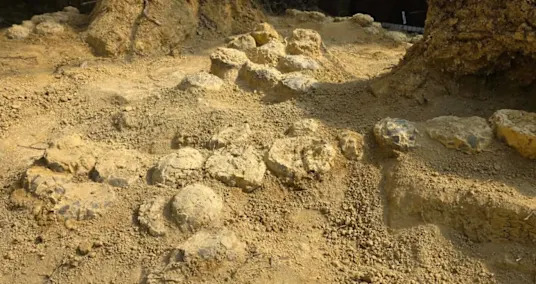
Imagine brushing away 72 million years of sediment and uncovering hundreds of dinosaur eggs, their shells still intact after surviving everything from asteroid impacts to ice ages. That’s exactly what happened at the Mèze fossil site in southern France, where paleontologists working through the winter months revealed one of the world’s most significant dinosaur nesting grounds. The discovery feels like stumbling upon a prehistoric treasure trove—if ancient titanosaurs had curated their own museum exhibits.
Ancient Nursery Preserved in Stone
Museum director calls the find an unprecedented gathering of fossilized eggs.
Alain Cabot, director-curator of the Musée-Parc des Dinosaures de Mèze, described the discovery as an “exceptional concentration” spanning 15 square miles of Upper Cretaceous rock. Over 100 eggs became visible within weeks of careful excavation, with many retaining their internal structures—a paleontologist’s equivalent of finding unopened time capsules. The fossil-rich layer extends far beyond the current dig site, suggesting this ancient maternity ward holds many more secrets waiting 70-72 million years for their moment in the spotlight.
A Snapshot of Cretaceous Family Life
Titanosaurs dominated the nesting ground, but smaller dinosaurs also called it home.
The eggs primarily belong to titanosaurs—those massive long-necked herbivores that would dwarf modern elephants. Yet scattered among these giants are smaller treasures:
Eggs from ankylosaurs
Tiny theropods, including the rare Prismatoolithus caboti, one of the smallest carnivorous dinosaur eggs ever discovered
Picture a Cretaceous suburbia where different species chose the same prime real estate for raising their young, much like how modern birds flock to protected wetlands during nesting season.
Modern Wonder Meets Ancient Mystery
Social media buzz reflects enduring fascination with dinosaur discoveries.
The museum’s Facebook announcement exploded with over 1,500 reactions and hundreds of shares, proving dinosaurs still captivate imaginations across generations. Visitors can now observe the ongoing excavation in person, watching scientists methodically reveal creatures that nested here when flowering plants were still evolutionary newcomers. The preserved floodplain environment—where periodic flooding rapidly buried eggs under protective sediment—created perfect fossilization conditions that geological time couldn’t destroy.
Each egg represents a moment frozen in deep time, waiting 72 million years for someone to rediscover the story of these ancient parents and their hopes for the next generation.
From the coolest cars to the must-have gadgets, GadgetReview’s daily newsletter keeps you in the know. Subscribe - it’s fun, fast, and free.
LATEST POSTS
- 1
 IDF strikes Hamas terror base in Lebanon, Health Ministry says 11 killed
 - 2Vaccine committee votes to scrap universal hepatitis B shots for newborns despite outcry from children’s health experts
- 3How the Iran war may affect your money and bills
- 4Vacation destinations in America
- 5Extraordinary Guinness World Records That Will Astound You





- See the 'amazing' photos of Earth taken on historic Artemis II moon mission
- They want better health care — so they're turning to crypto startups
- Manual for Tracking down One of a kind Store Inns
- Iran war drives global fertilizer prices up, raising food cost fears
- When Would it be a good idea for you to Look for Help from a Criminal Legal counselor?
- Nigeria police charge Joshua driver with dangerous driving over fatal crash
- Cuba fights to contain spread of mosquito-borne chikungunya virus
- Tech Patterns: Contraptions That Will Shape What's in store
- IDF begins destroying homes used by Hezbollah as forces move deeper into southern Lebanon